Welcome to the Mathematical World!
Carl Friedrich Gauss
The Prince of Mathematicians
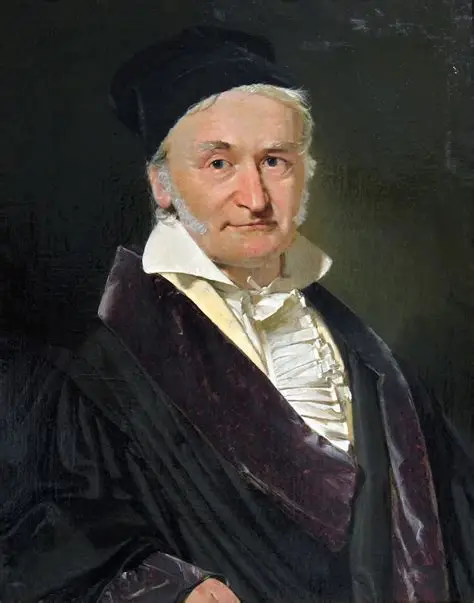
Carl Friedrich Gauss (1777–1855) was a German mathematician, astronomer, and physicist whose work shaped numerous fields, including number theory, statistics, analysis, geometry, geodesy, magnetism, and astronomy. Born in Brunswick, in the Duchy of Brunswick-Wolfenbüttel, Gauss displayed extraordinary talent from a young age. His intellectual brilliance earned him the title “Prince of Mathematicians,” and his discoveries have left a lasting legacy across both theoretical and applied sciences.
Early Genius
One of the most famous anecdotes from Gauss’s childhood occurred when he was about eight years old. His teacher, hoping to keep the class occupied, asked students to sum the integers from 1 to 100. While others began laboriously adding them one by one, Gauss immediately recognized a pattern: pairing the first and last numbers (1 + 100 = 101), the second and second-to-last (2 + 99 = 101), and so on. With 50 such pairs, each summing to 101, the total became \( 50 \times 101 = 5050 \). This insight corresponds to the well-known formula for the sum of the first \( n \) positive integers:
\[ S = \frac{n(n+1)}{2} \]
This story is often cited as an example of Gauss’s natural mathematical intuition and ability to detect structure where others saw only brute calculation.
Astronomy and Ceres
In 1801, the Italian astronomer Giuseppe Piazzi discovered a new celestial body, later named “Ceres,” orbiting between Mars and Jupiter. Unfortunately, after a short period of observation, Ceres disappeared behind the Sun, and astronomers feared it would be lost forever. Using an innovative method of orbital calculation that he devised himself, Gauss predicted the exact location where Ceres would reappear months later. When astronomers looked in Gauss’s predicted position, they found it almost immediately. This triumph not only demonstrated his genius but also revolutionized astronomical computation, enabling more precise predictions of planetary and asteroid movements.
Mapping Germany
Gauss made significant contributions to geodesy — the science of measuring Earth’s shape and surface. In the early 19th century, he was tasked with creating a detailed map of the Kingdom of Hanover. To accomplish this, he built custom surveying instruments and invented new error-minimization techniques, including the method of least squares, which remains a cornerstone of modern data analysis. Gauss personally traversed forests, hills, and plains to take accurate measurements, combining his theoretical skill with practical fieldwork. This project not only improved cartography but also advanced statistical and computational methods.
Later Years and Influence
Although Gauss was a devoted researcher, he was not known for enjoying formal teaching. He preferred to work privately and mentored only a select few students. However, one of his protégés was none other than Bernhard Riemann, who would revolutionize geometry and profoundly influence physics through his work on curved space — a foundation for Einstein’s general relativity. Gauss recognized Riemann’s talent early, offering guidance and support to his groundbreaking ideas, thus passing the torch to the next generation of mathematical giants.
Gauss’s work continues to underpin vast areas of modern science and engineering, from GPS navigation to financial modeling. His blend of deep theory, practical application, and precision craftsmanship ensures that his influence will remain for centuries to come.

All rights reserved by the Mathematical Unity
Contact: +8801400044645
Email: mathematicalhorse1453@gmail.com
Our Discord Server: Mathematical Unity [Ulus Riyadiyat]